Is Facebook advertising the best way to boost your business?

Is Facebook advertising the best way to boost your business?
The world of advertising is transforming. In a society saturated by information, it’s harder than ever to grab the attention of potential customers. So, just how do you get people to take notice of your business? Try reaching them through social media. Facebook has nearly 1.8 billion monthly active users, so advertising on its platform could be the answer. Learn more about how Facebook advertising works and find out how Search Engine Pros can help you harness its power to boost your business.

Why use Facebook advertising?
Facebook advertising tips and ideas

Here are the key reasons why Facebook advertising wins over traditional ad formats like print, billboard, radio, TV and even Google Adsense:

  • Facebook ads are far cheaper in terms of cost to reach 1,000 people. For example, Buffer app found that spending just $5 per day on Facebook adverts bought them 9 likes, 1 click to their homepage and 787 new views. Moz claims that spending $1 per day on Facebook gets your brand in front of 4,000 people.
  • Facebook ads run on pay-per-click or pay-per-day impressions, similar to Adsense. That means that you’re in control of your budget and can set daily caps or limits on the total campaign.
  • Facebook ads are highly visible because they’re placed directly in users’ news streams.
  • You can target specific audiences with Facebook ads based on a number of factors including interests, age, behaviour, connections, languages, gender, location, religion, politics, marital status and occupation.
  • Facebook allows you to find existing customers using contact lists, web traffic from your site or activity in your app. This allows you to remarket to an audience who has already visited your site and has some interest in your business.
  • Once you have a converting audience you can use the Lookalike Audience feature to reach new people who have similar profiles.
  • You can test and track the success of your advertising campaigns in real time with Facebook Analytics and adjust them using the Adverts Manager tool.

Exactly how does Facebook advertising work?
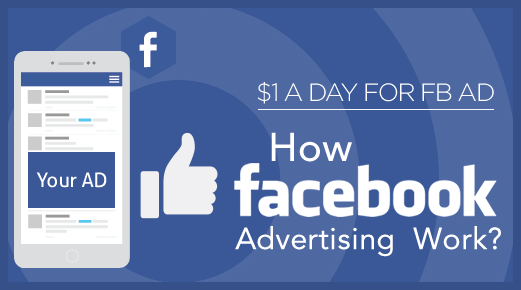
Facebook advertising tips and ideas

Facebook has made over $6.4 billion in advertising revenue in the second quarter of 2016 alone. The social network has become a key leader in the ad field by creating the most sophisticated consumer profiling ever.  Here’s how it works:

  • When you’re logged into Facebook, it tracks everything you do on the internet. This allows it to build a profile of your lifestyle including what brands you like, your hobbies and interests, favorite foods, music, films and so much more.  
  • Facebook knows where you live and uses your electronic device and location settings to figure out key information about you.
  • The company also uses consumer data that has been sourced by credit companies and research firms like Experian to build a fuller idea of your lifestyle habits.

This might sound pretty scary for consumers, but it’s a dream for advertisers who can use this information to target very specific audiences. Plus, if they wish, Facebook users can adjust their privacy settings using the Ad Preference Tool to avoid being tracked.

What makes Facebook advertising even better is that it has 10 different ad methods which cater to different business aims:

  1. Boost your posts to a wider audience.
  2. Promote your page to get more likes.
  3. Send people to your website.
  4. Increase conversions on your website.
  5. Get people to install your app.
  6. Increase engagement in your app.
  7. Reach people who live near your business.
  8. Get people to attend an event.
  9. Get people to claim an offer, such as a discount on next purchase or enter a sweepstake.
  10. Generate video views.

How can we help you with Facebook advertising?

Facebook advertising tips and ideas

Whether you want to drive sales or increase brand awareness, with a little bit of time, money and testing, Facebook ads can provide a real boost for your business. If you need assistance setting things up, Search Engine Pros can help in the following ways:

  • We can work with you to assess your advertising needs.
  • Set up your Facebook advertising account
  • Test various adverts and analyze what works best.
  • Set up a regular advertising budget and schedule your Facebook ads.

Contact us to get started with your Facebook advertising campaign.

A Fast Start To 2017 For Click-To-Call Ads

Living in a mobile-first world has made it easier than ever to pick up the phone and talk to a business directly. That’s why we’ve continued investing in call innovations based on the great feedback we’ve heard from you. From call-only ads for marketers who prioritize calls to imported call conversions that allow you to upload your own call conversion data directly into AdWords, we’ve strived to drive more high-quality calls to your business in three main ways:

  1. Simplified workflows so you can set up click-to-call ads faster
  2. Better ad experiences that make it easier for people to call you
  3. Detailed call reporting that shows which parts of your campaigns drive the most valuable calls 

We have new updates coming soon across these areas to help you improve your calls performance.

Get your call extensions up and running more quickly

Account-level call extensions will begin rolling out this week to help you set up call extensions at scale. You can implement them once across your entire account rather than adding them multiple times to individual campaigns and ad groups.
In the coming months, we’re also rolling out automated call extensions to more advertisers globally to help you set up call extensions more quickly. AdWords will identify landing pages that already feature a prominent phone number, and automatically set up a call extension and call reporting for this phone number to help you drive more calls to your business

New year, new look for click-to-call ads

In addition to making call extensions quicker to set up, we’re improving the ad experience to help consumers call you more easily. For example, we started testing business names in the headlines of call-only ads last year to help advertisers maximize high-quality calls from people who intend to call them.

“Introducing business names to call-only ads has improved the quality of calls we drive from Google Search for clients across our agency. We’ve been able to showcase their brands more clearly and increase user trust, which has led to significantly higher clickthrough and call conversion rates.”
Kevin Quinlan, President of wommster.com

We’re now rolling this change out globally and will continue experimenting with other new features in click-to-call ads, including testing caller satisfaction ratings to show consumers which businesses are delivering a great user experience over the phone.

New reporting for keyword and ad-level call details

Measuring performance from your click-to-call ads is essential for making informed decisions about your spend and optimizations. AdWords call reporting is easy to set up and available in 23 countries around the world at no additional cost to show you useful insights and conversions from the calls you’re receiving. We’ll soon be adding new call details to your keyword and ad copy reports. Additional columns for “Phone impressions” and “Phone calls” will give you a more complete view of call performance and help you see where there are opportunities to improve. For example, consider using call-only ads on keywords with the highest phone-through rates, or decreasing wait times when you have customers on the phone to improve call conversion rates.
We hope these new updates to click-to-call setup, ad experiences and reporting will help you ring in 2017 with great calls performance. To learn more, visit the Help Center and read our best practices for driving phone calls to your business and optimizing the caller experience.

Source: Official Google Webmasters Blog

Google Manufacturer Center Opens Self-Sign Up, Letting Even More Manufacturers Elevate Their Brands Online

Many brands and manufacturers rely on individual retailers to showcase and sell their products; however, this can make distributing and monitoring manufacturer product information complicated, as those retailers may not always have the most accurate and up-to-date product details. In 2015, we launched Google Manufacturer Center to enable these brands to offer enhanced product images, descriptions, and variants for a more consistent brand experience across Google. Since then, thousands of brands have taken advantage of the tool to best represent their products to shoppers, to access unique analytics and insights — and ultimately — to improve the performance of Shopping ads featuring their products.

Today, we’re excited to announce the launch of self-sign up for Manufacturer Center, which will allow even more brands to manage their product information across Google. Now, brands can set up their accounts in a matter of minutes and start submitting authoritative, detailed, and rich product information (including images, titles, descriptions, videos, and more) to help their products stand out in a crowded marketplace — whether shoppers are looking for inspiration, to compare products, or to make a purchase.

Below, we’re highlighting two recent success stories from leading brands that are investing in rich product content to best showcase their products to shoppers on Google.

Johnson & Johnson drives a premium brand experience with high-quality product images

Johnson & Johnson, manufacturer of popular household brands such as Band-Aid, Neutrogena, and more, has been uploading rich product data to Manufacturer Center over the past year.

“Google Manufacturer Center provides us as brand manufacturers, the ability to influence product experiences, drive purchase decisions, and surface high quality and accurate product information, content, and product imagery,” said Faisal Rangwala, Senior Manager of eCommerce Strategy at Johnson & Johnson.

Johnson & Johnson is driving a premium search experience for products such as their light therapy acne treatment mask, by uploading more accurate and descriptive data.

As a result, when compared to category benchmarks, Johnson & Johnson realized:

  • A 22% increase in impressions, helping even more customers discover their brand through search results
  • A 27% increase in clicks, engaging more potential customers with their retailers’ Shopping ads.

Safavieh gains impressions and qualified clicks by uploading better product data

International home furnishings company Safavieh submitted data to Manufacturer Center to better showcase their collections through Shopping Ads. Prior to their participation in Manufacturer Center, they relied on retail partners to submit product information to Google. As a result, they often found that their products were displayed in Google Shopping search results without the most up-to-date images, product attributes, videos or detailed descriptions.
“Manufacturer Center has provided us with a great way of engaging our customers with more accurate, useful information. We can’t say enough about how being part of Google Manufacturer Center is helping to drive more traffic to our website, our retail partners’ websites, and ultimately greater sales for our products.” said Arash Yaraghi, CEO at Safavieh.

With Manufacturer Center, Safavieh has captured consumer attention by providing more enhanced content, so when a consumer searches for “rugs”, Safavieh can showcase multiple high-resolution zoomable images, YouTube videos, and longer descriptions.

By uploading richer content and videos to improve their Shopping ads, when compared to category benchmarks, Safavieh achieved:

  • A 46% increase in impressions, improving product discoverability on Google
  • A 35% increase in clicks, with users spending more time on retailer’s sites

Getting started with Manufacturer Center

Once brands open their account, they can upload their product data directly to Manufacturer Center or work with a data partner that can streamline their product data submission to Google. A list of our approved Google Shopping data partners can be seen on our partner page. To learn more about Manufacturer Center or to sign up, visit our website.

Source: Official Google Webmasters Blog

Increase Web Site Traffic with SearchEnginePros.com

Increase Web Site Traffic with TheSearchEnginePros.com

A webmaster seeking to increase web site traffic faces many challenges in the age of the search engine — especially when attempting to find web marketing services to match his or her CMS system. Implementation of SEO for CMS based websites can be highly challenging. It is important that we find a reliable SEO Campaign Management Specialist to implement SEO for your websites.

Santa Barbara, CA – Today website development costs have reduced dramatically and launching a website has become just a breeze with all the free tools and open sources systems that are available. One of the latest open source systems that meet most requirements is Joomla. This is one of the most powerful and sophisticated open source systems. Businesses can launch robust websites in a matter of few clicks using the built-in tools available with Joomla. This saves a lot of development time to launch highly professional websites with fraction of the cost, and a webmaster can immediately increase web site traffic by deploying simple yet sophisticated Joomla plug-ins for additional site functionality. Besides the cost and time advantage, there are number of other advantages in using Joomla. However, along with these advantages comes an undeniable and critical disadvantage. There are many complications in terms of implementation of SEO for Joomla based websites.

Since the cost of website development has come down drastically and there is a great need to launch websites to promote one’s business online. Every day thousands of websites are launched. In such circumstances, one can easily get lost in the competition. Therefore, businesses need to promote their websites and increase website traffic, and one of the best ways of gaining visibility online is to implement search engine optimization. As noted already implementing SEO for Joomla-based websites presents special challenges. It requires a great level of experience to optimize Joomla-based websites. Not all web development companies are capable of developing an SEO Friendly CMS; only a company with search engine optimization experience can create SEO-friendly systems. Web development companies will be more concerned about creating functionally robust systems rather than being preoccupied with creating SEO-friendly CMS. Therefore, it is crucial that website owners find an SEO Campaign Management Specialist who can assist with Joomla Search Engine Optimization. Web marketing services capable of handling CMS natural search optimization are surprisingly rare given the popularity of such software.

One of the best places to go for Joomla Search Engine Optimization Tips and for SEO assistance is SearchEnginePros.com. They offer specialized web marketing services that will cater to all your search engine optimization needs and help you increase website traffic. They have the needed expertise to deal with Joomla Search Engine Optimization. They offer all types of web marketing services that will increase online popularity and targeted traffic to websites. There are hundreds of web marketing services online that promise to get website top rankings in Google and in other major search engines. Among these, only a fraction of search engine optimization companies meets their promises. This caused a lot of distrust among the website owners regarding SEO and web marketing services. The nature of web marketing is such that one cannot so easily guarantee results because there are too many variables that decide a website’s ranking and popularity. Only companies such as searchenginepros.com that have mastered the SEO concepts can produce the desired results. For more information on reliable SEO services visit,

searchenginepros.com

Making YouTube Better In A Mobile, Cross-Screen World

Throughout the day, people turn to their nearest device for help making choices about what to do, what to watch, or even what to buy. More than anywhere else, these moments happen on Google and YouTube, and more often than not, they happen on mobile.

With over 50% of YouTube views now on mobile, we’re focused on building scalable solutions that will work across screens. To do this, we’re announcing changes today that allow advertisers and agencies to better measure their campaigns and reach their audience on YouTube across screens, while continuing to offer users control over their ads experience on YouTube.

Next generation insights and reporting

We’re developing a new, cloud-based measurement solution over the next year that will be at the cutting edge both in generating advertiser insights and in protecting privacy and security across Google and YouTube. With this new solution, advertisers will have access to more detailed insights from their YouTube campaigns across devices, so they can better understand the impact of their campaigns on their highest-value customers. For instance, a car manufacturer could get a rich understanding of how YouTube ads across devices influenced a specific audience (like previous SUV buyers).

As we build this new measurement solution, we will continue to work closely with leading MRC accredited vendors including comScore, DoubleVerify, IAS, MOAT, and Nielsen. Together, these vendors account for the vast majority of third-party measurement on YouTube. These collaborations will enable agencies and advertisers to continue to independently measure and verify the performance of their campaigns.

Improved ways to reach your audience

As more viewership on YouTube shifts to mobile, we’re making it easier for advertisers to deliver more relevant, useful ads across screens. Now, information from activity associated with users’ Google accounts (such as demographic information and past searches) may be used to influence the ads those users see on YouTube. So, for example, if you’re a retailer, you could reach potential customers that have been searching for winter coat deals on Google and engage with them with your own winter clothing brand campaign at just the right moment. In addition, we’re creating new ways for advertisers to use their customer data to reach their highest-value customers on YouTube using Customer Match. For example, that same retail advertiser could reach customers that signed up to receive special offers in their stores.

User controls built for the mobile world

In addition to the advertiser solutions announced above, users will continue to have control over what ads they see on YouTube and across Google with the controls in My Account, and as always, we maintain strict policies against sharing personally identifiable information with advertisers. In the coming weeks, we’ll enable a user control that was built with cross-screen viewing in mind: if a user mutes an advertiser on Google Search, ads from that advertiser will also be muted when they watch on YouTube. For example, if you see a gym membership ad but have already signed up for a gym as part of your New Year’s resolution, you can mute that ad in Search, and you won’t see ads from that advertiser on YouTube.

Paving the path for the future

As we roll out these changes, we’re supporting the platforms where the majority of users watch today rather than continuing to invest in the legacy technologies of the desktop web. As a result, we’ll be limiting the use of cookies and pixels on YouTube starting this year.

While technologies like pixels and cookies still have a role in the broader ecosystem, most were built for a single screen—neither pixels nor anonymous cookies were designed for the ways in which users increasingly watch content on YouTube, like on the mobile app or in the living room. This can lead to inconsistent measurement and less relevant ads across screens, making it harder for people to control the ads they see or the data used to show them.

By investing more in the mobile first solutions we’re announcing today, users will have more choice and transparency over how they experience ads on Google and YouTube, and advertisers will have more opportunities to be present and relevant in the moments their audience chooses to watch.

Source: Official Google Webmasters Blog

Google Seller Ratings: Demystified

Google Seller Ratings: Demystified

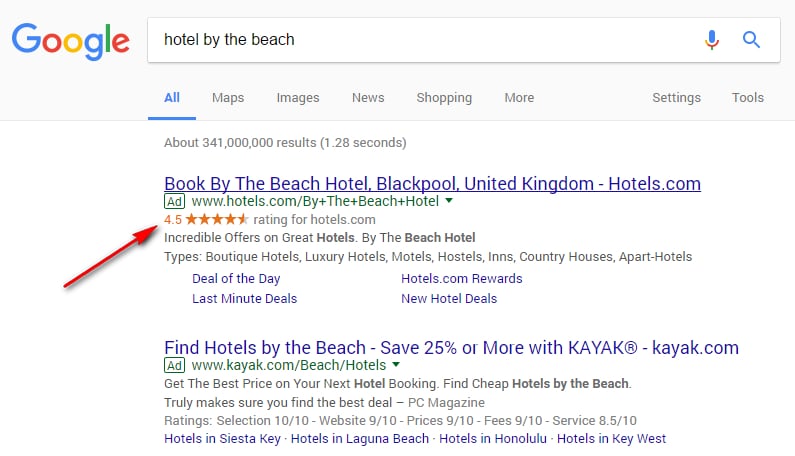
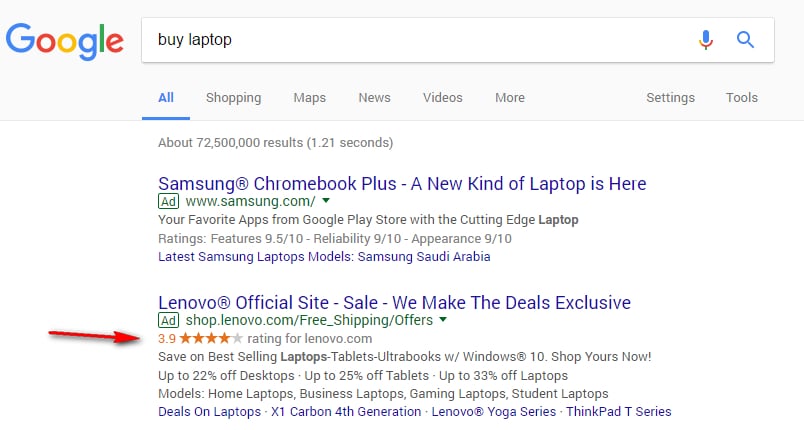
Have you noticed the gold stars next to some Google ads? Or perhaps you’ve heard the term ‘seller ratings’ but have no idea what that means or how to get your business rated? Then we’re here to demystify the whole process for you. Read on to find out exactly what Google seller ratings are and how they can dramatically increase the performance of your online ads. We’ll also tell you how to get great Google seller ratings for your business.

google seller rating

Google seller ratings help online shoppers make informed purchasing decisions. The automated extension collates information from independent review sites to create an overall rating for your business. This is displayed in the form of gold stars beneath your Google ads, which provides an instant, visual snapshot of how customers rate your business on a scale of one to five.  

Google seller ratings appear across all browsers and platforms and are free for businesses; you don’t pay if a customer clicks on your star rating. Let’s take a look at some examples of Google seller ratings from around the internet:

Travel

11

Retail

22


Why do you need Google seller ratings?

Great Google seller ratings can really boost your business, here’s how:

  • Ratings increase the performance of your ads. Google seller ratings increase the click-through rate (CTR) from adverts on average by 17%. 
  • Positive reviews matter to consumers. This report shows that 92% of customers read online reviews and 88% of online shoppers take reviews into account when they’re making purchasing decisions.
  • High Google seller ratings encourage customers to trust your business; 68% of people questioned in the above survey said positive reviews made them trust a business more.
  • Star ratings are proven to be the most influential ratings factor, says the same report. They provide an eye-catching visual component to ads.
  • Seller ratings are useful if you don’t have a strong, well-established brand yet or work in an industry where many of your competitors don’t have reviews.

How exactly does Google create your seller rating?

Google aggregates independent customer reviews from these sources to produce seller ratings:

  • A list of 31 independent review sites such as Trust Pilot, PriceGrabber, ResellerRatings and Shopper Approved.
  • Google Trusted Stores, which is a certification program for online businesses. Customers can rate their shopping experiences through the program.
  • The results of Google shopping research.
  • StellaService, a third-party company that measures the quality of customer care for online businesses.
  • Google consumer surveys, which collect data about businesses and domains.

Google filters out reviews which it considers are suspicious or untrustworthy and may not show reviews for items or services unrelated to your Google ad. You can choose to disable the seller ratings function if you wish.

How do you get Google seller ratings?

To be eligible to receive seller ratings on your Google ads, your business has to meet the following criteria:

  • You must have at least 150 reviews from the last 12 months.
  • You must have an average star rating of 3.5 or higher.
  • In your AdWords account, you need to set your campaign type to: ‘Search Network with Display Select,’ ‘Search Network Only,’ or ‘Search and Display Networks.’
  • Seller ratings will only be displayed when searching from: google.com, google.co.nz, google.co.uk, google.nl, google.com.au, google.de, google.co.jp, google.fr, or google.com.br.
  • At least 10 reviews must be in the same language as the searcher’s Google interface. For example, if a searcher finds you through Google New Zealand then 10 reviews must be in English for seller ratings to show up. If they’re searching from France, 10 reviews must be in French.

In addition, make sure that all shopping and review sites you use list your correct business name and URL to allow Google to accurately aggregate your rating.

Which review websites should you use and how much do they cost?

Which review websites should you use and how much do they cost?

The best way to get Google seller ratings is to join a review site that has the following features:

  • It must be listed as one of the 31 Google licensed partners.  
  • The site should allow you to monitor reviews and respond to negative feedback.
  • You should be able to email previous customers to request a review.
  • The site should verify your reviews by only allowing users to leave a review after they’re actually bought something from you.  
  • The site should allow you to share your reviews on your social media channels.

Rating and review sites usually charge a monthly membership fee and you often have to submit an enquiry to get a tailored quote. Here are some prices and features for the most popular rating sites which Google uses to produce their seller ratings:

trust pilot

Trust Pilot

Trust Pilot verifies reviews by asking for proof of purchase such as receipts and order confirmations. You can easily contact past customers for reviews and use Hootsuite to share your reviews on social media. Trust Pilot allows you to submit one response to each review.

Price: monthly packages start at $599.

shoppers approved

Shopper Approved

Shopper Approved has a ‘pay-as-you-grow’ pricing model with a free trial. You can easily collect and share reviews and it even allows reviewers to submit video testimonials. Shopper Approved alerts you to negative reviews and allows you to respond in private; the customer is later given a chance to update their review.

Price: starts at $99 per month.

reviews co uk

Reviews.co.uk

Reviews.co.uk shows which reviews are verified with invoices or order IDs and which aren’t. The site also allows you to reply to reviews and flag any that are suspicious. You can share reviews on social media and customers are able to attach review photos and ask you direct questions through a Q&A interface.

Price: costs between $29 and $199 per month.

reseller ratings

ResellerRatings

ResellerRatings is the biggest review site but it doesn’t have a transparent pricing system and has a few bad reviews itself. The site shows which reviews have been verified and which haven’t; you can respond to reviews and share them on social media.

Price: costs vary per month according to ResellerRating’s independent algorithm.

Yotpo

Yotpo

Yotpo displays both verified and unverified reviews, which you can respond to and share on social platforms. Customers can attach review photos and you can import existing customer reviews from other outlets.

Price: start from $400 per month.

seller reviews

Tips for gaining more seller reviews

So you’ve signed up to a ratings site, but how can you encourage customers to give you a great write-up? Here are some quick tips for gaining more seller reviews:

  • Ask previous clients to review you.
  • Provide an awesome service so customers feel compelled to leave positive feedback.
  • Request feedback at the right stage of the customer journey; send shoppers an email straight after the transaction has been completed or even add a survey form to the confirmation page. Test the placement of your review requests to see what works best.
  • Make it easy for customers to leave feedback, don’t ask them to log-in or navigate through multiple pages. Instead, make sure all they have to do is simply select a star rating and leave space for any comments they want to add. Ensure that your review request system works on all browsers and across all platforms, especially mobiles.
  • Monitor your reviews and respond to negative feedback. This will allow you to resolve problems and show potential customers that you care about the service you deliver and want to rectify issues.
  • Bear in mind that once you have over 150 reviews, you may have to wait a few weeks for this information to be indexed by Google before your star seller ratings start showing on your ads.

So now we’ve demystified Google seller ratings for you it’s time to go out there and boost your business by collecting your own golden stars.

Reminder: Transition To Expanded Text Ads Before January 31, 2017

This is a friendly reminder that starting on January 31, you’ll only be able to create and edit text ads using the expanded text ads format. You’ll no longer be able to create standard text ads. While this will be the last date to create them, existing standard text ads will continue to serve. Expanded text ads can deliver great results, particularly with a commitment to testing new creatives.

As one of the top places people go online to search for apartments, Apartments.com knows the importance of having a strong digital presence. Wanting to provide renters with even more information about its listings, Apartments.com added expanded text ads to its Search campaigns. Apartments.com’s results were strong across its campaigns. It saw 15% and 10% increases in CTRs for expanded text ads on mobile and desktop, respectively.
While making similar improvements to your ads, keep these best practices in mind:

  • Implement multiple versions of your ads. Aim for at least 3-5 per ad group.
  • Leave your standard text ads running.  You can’t create new ones, but the old ones can still serve. Don’t delete them until they stop receiving impressions on their own or the message is no longer accurate.
  • Plan to optimize your ad rotation for clicks or conversions. These options give preference to ads that are likely to perform better.
  • Focus your testing on headlines. They’re the most important part of your ads.
  • Consider shorter headlines on things like brand terms where someone might not need more info.
  • Iterate new ads based on previously successful creative. Learn from what already works.
  • Add terms from user queries and your keywords in your longer headlines whenever appropriate.

Along with those best practices, remember that after January 31 you can pause and resume standard text ads, but it’s best to create new expanded text ads.
As you prepare for expanded text ads to become the only way to create new text ads, check out our best practices guide for creating effective ads or our previously-hosted Hangout-on-Air for more advice. Take advantage of AdWords Editor, the AdWords API, or the ETA Transition Helper to make these changes across your entire account.

Source: Official Google Webmasters Blog

1 2 3