25 Advanced Search Engines (Other Than Google)

Advanced Search Engines 1

It may come as a shock to learn that Google is not the end-all be-all search engine. There are many search engines out there, much more than the 25 included in this list.

Learning how Google stores and utilizes the information you search for may lead to seeking out a different, more private search engine.

Which search engine is right for you? It depends on what you are searching for and what you are interested in finding.

Are privacy and tracking options important to you? Are you looking for academic material or strictly for video clips? The search engines you use can help better define your search, and get you the answers you need more quickly.

Thankfully, you have options! Keep reading to find which search engine best fits your needs.

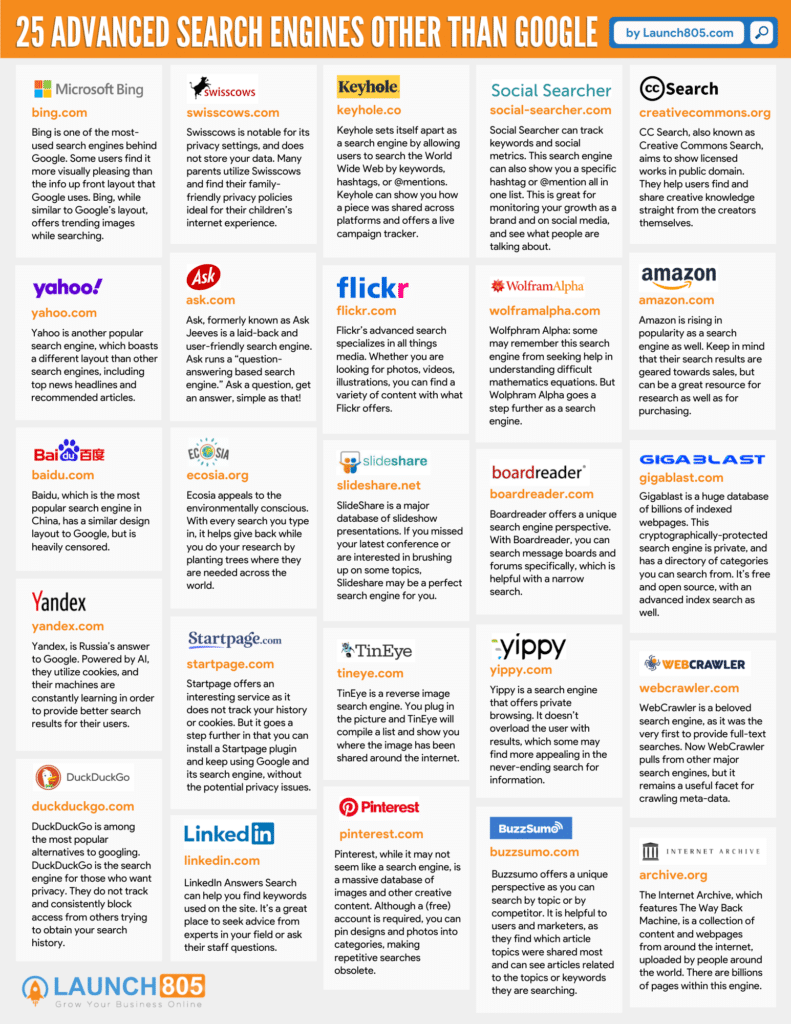
25 Advanced Search Engines (Other Than Google)
  1. Bing is one of the most-used search engines behind Google. Some users find it more visually pleasing than the info up front layout that Google uses. Bing, while similar to Google’s layout, offers trending images while searching.
  2. Yahoo is another popular search engine, which boasts a different layout than other search engines, including top news headlines and recommended articles.
  3. Baidu, which is the most popular search engine in China, has a similar design layout to Google, but is heavily censored.
  4. Yandex is Russia’s answer to Google. Powered by AI, they utilize cookies, and their machines are constantly learning in order to provide better search results for their users.
  5. DuckDuckGo is among the most popular alternatives to googling. DuckDuckGo is the search engine for those who want privacy. They do not track and consistently block access from others trying to obtain your search history.
  6. Swisscows is notable for its privacy settings, and does not store your data. Many parents utilize Swisscows and find their family-friendly privacy policies ideal for their children’s internet experience.
  7. Ask.com formerly known as Ask Jeeves is a laid-back and user-friendly search engine.  Ask runs a “question-answering based search engine.”  Ask a question, get an answer, simple as that!
  8. Ecosia appeals to the environmentally conscious. With every search you type in, Ecosia helps give back while you do your research by planting trees where they are needed across the world. They are privacy-friendly and utilize Bing and their own algorithms to bring you your results.
  9. Startpage offers an interesting service as it does not track your history or cookies. But it goes a step further in that you can install a Startpage plugin and keep using Google and its search engine, without the potential privacy issues.
  10. Pinterest, while it may not seem like a search engine, is a massive database of images and other creative content. Although a (free) account is required, you can pin designs and photos into categories, making repetitive searches obsolete.
  11. Keyhole sets itself apart as a search engine by allowing users to search the World Wide Web by keywords, hashtags, or @mentions. Keyhole can show you how a piece was shared across platforms and offers a live campaign tracker. Keyhole utilizes social listening online and provides analytics to help improve your online marketing strategies.
  12. Flickr’s advanced search specializes in all things media. Whether you are looking for photos, videos, illustrations, you can find a variety of content with what Flickr offers.
  13. SlideShare is a major database of slideshow presentations. If you missed your latest conference or are interested in brushing up on some topics, Slideshare may be a perfect search engine for you.
  14. TinEye is a reverse image search engine. You plug in the picture and TinEye will compile a list and show you where the image has been shared around the internet.
  15. LinkedIn Answers Search can help you find keywords used on the site. It’s a great place to seek advice from experts in your field or ask their staff questions.
  16. Social Searcher can track keywords and social metrics. This search engine can also show you a specific hashtag or @mention all in one list. This is great for monitoring your growth as a brand and on social media, and see what people are talking about.
  17. Wolfphram Alpha: some may remember this search engine from seeking help in understanding difficult mathematic equations. But Wolphram Alpha goes a step further as a search engine. The website offers expert knowledge in a variety of fields, and is a hub of helpful videos and examples to explain any question you may have. It is privately owned and doesn’t track your searches.
  18. Boardreader offers a unique search engine perspective. With Boardreader, you can search message boards and forums specifically, which is helpful with a narrow search.
  19. Yippy is a search engine that offers private browsing. It doesn’t overload the user with results, which some may find more appealing in the never-ending search for information.
  20. Buzzsumo offers a unique perspective as you can search by topic or by competitor. This search engine is helpful to users and marketers, as they find which article topics were shared most and can see articles related to the topics or keywords they are searching.
  21. CC Search, also known as Creative Commons Search, aims to show licensed works in public domain. They help users find and share creative knowledge straight from the creators themselves. If you or your company want to avoid copyright claims, using CC Search may work for you.
  22. Amazon is rising in popularity as a search engine as well. Keep in mind that their search results are geared towards sales, but can be a great resource for research as well as for purchasing.
  23. Gigablast is a huge database of billions of indexed webpages. This cryptographically-protected search engine is private, and has a directory of categories you can search from. It’s free and open source, with an advanced index search as well.
  24. WebCrawler is a beloved search engine, as it was the very first to provide full-text searches. Now WebCrawler pulls from other major search engines, but it remains a useful facet for crawling meta-data.
  25. The Internet Archive which features The Way Back Machine, is a collection of content and webpages from around the internet, uploaded by people around the world. There are billions of pages within this engine.

Privacy concerns are not the only reason users may seek out other advanced search engines other than Google. Some users have a more specific search request or want to search a database without the possibility of copyright claims.

From Swisscows, known for its privacy settings, to TinEye, an advanced image search engine, there are many search engines that hold their own against Google, by offering niche or advanced features.

Really it comes down to which search engine best suits your needs.

Which search engine is your favorite and why? Let me know in the comments below!

SEO Articles: Creating Website Posts That Get Found

SEO Articles: Creating Website Posts that Get Found
SEO Articles


“SEO articles 
are extremely effective at generating more awareness for your business on the internet andcommonly used by search engine optimization specialists to generate top ranks on search engines.”

SEO writing is one of the fastest growing marketing mediums for small businesses today. SEO article writing is a strategic business writing style where the objective is to rank high in the search engines for a particular keyword or key phrase.   Ideally, you will have several different keywords to use, and each keyword should normally be used at least once per paragraph – though the exact guidelines for SEO article writing vary from one company to the next depending on comfort levels with writing styles.

In the past 10 years I have written and published over 10,000 pages of SEO articles on the web for my clients, and my own web sites.   I was fortunate to have the opportunity to work under some very bright SEO writers, and I picked up some gems of web publishing wisdom from them.   Below are a few quick tips that might help you write your SEO articles in a way that will increase your ranks on Google and other major search engines.  Enjoy.

1.  SEO articles are “strategic content’. 

seo-articles-strategic-content

Search engine optimized articles are considered to be “strategic content” for your web site (relevant + keyword rich).   Strategic content is essentially a block of informational (typically non-self promotional) text that contains the keywords that are important to your business.  Google loves web sites that contain helpful, objective keyword rich articles.

2.  SEO articles strike a balance between Ernest Hemingway and Google.  

thumb-keyword-research-report-phrases

Always err on the side of readership and style, when it comes to stuffing keywords inside.  The goal of the SEO Article is to drive people to your web site from the search engines, and do so in a way that is graceful, not spammy.   In most cases readers will spend less than a minute glossing the SEO article, and then click to the homepage (internet surfers are usually in a hurry).    SEO articles are generally 500-1000 word blocks of factual, helpful ‘informational’ text (writer is confined to a set of keywords).  The title of your web page, blog post, blog article, etc, is one of the most important areas to consider.  Consider adding your target keyword first like this:  Keyword – 7 Big Mistakes To Avoid.  The reasoning behind this is because Google considers the keywords in the beginning of your title more important than those at the end of your title.  Also consider using this little tool for keeping your titles and descriptions within an acceptable character range.

3.  SEO articles are ‘educational marketing’  (pull marketing).

SEO articles are 'educational marketing'

SEO articles educate and inform customers in a non self promotional way (informational).  Part of the success of a business today depends on the business owners ability to add value to the customer base through their web site.  Adding SEO articles is one of the best ways to do this because they increase credibility levels at your site, and generate top ranks in Google search results.

4.  SEO articles are typically written specifically for the search engines.

seo-article-writing-dollars

SEO articles help search engines find your product or service.    It seems that the majority of writers today, including press release writers, are including SEO keywords in their articles to increase visibility in the search engines.  SEO articles are specifically written for search engines.  The reason companies today are writing SEO articles is primarily because they make the phone ring with new prospects.  SEO articles generate awareness of a product or service online and help prospects easily discover your product or service.   New visitors at your web site results in more sales and more success.  Google loves to rank web sites highly that have helpful directories of how-to articles.

5.  SEO articles are a different animal than Magazine articles.

SEO articles are a different animal than Magazine articles.

This is often times a point of confusion for business owners, poets and journalists.  SEO articles tend to be more factual in nature, not taking serious points of view on the industry, but rather, just finding creatives ways to connect the target audience with the search engine audience by using embedded keywords that customers use when searching for your product or service.   In contrast, with magazine articles, the writer has full freedom of expression, and generally has a goal of getting the reader excited.  The type of writing that you see in magazines is more motivational and compelling.  With most SEO articles, this will not be the case and shouldn’t be the case.  SEO articles aim to be short, factual, helpful and keyword rich. A greater degree of flexibility is typically afforded for the literary aspects of SEO articles for this reason.  SEO articles are not written for a magazine or for your homepage.  They are written primarily for the search engines and to build in-roads to your web site (links), and ultimately to generate more traffic for your web site.  That said, they are still helpful and informative for the reader.

6.  SEO articles have Twitter streams or RSS streams.  

SEO articles have Twitter streams or RSS streams.

Google loves to rank fresh content. Hence, it would make sense to keep your pages (blog posts) fresh.  You might consider adding a Twitter Stream (such as the one you see at the bottom of this SEO article) to keep the page fresh.  *Adding video/audio helps as well in terms of keeping the visitor on your website for a longer period of time (time on page is measured as well when ranking websites).

7.  SEO articles using a list based writing format.

SEO articles use List Based Writing

This is because most people on the web are scanning, not reading.  Most people prefer to read list based content.  Just take yourself as an example, do you prefer reading big blocks of text on the web?  Probably not.  List based writing is a way to get your message across on the web.  SEO articles utilize proper keyword density.  Do not overuse the keywords. If you saturate the article with too many SEO keywords, it is difficult to maintain the flow and a style of the article.  Always opt for readership over stuffing a bunch of keywords in the article.  Google may even penalize you for “keyword stuffing” if your keyword density is too high.

8.   SEO articles bold and italicize the SEO Keywords.  

 SEO articles

Bolding and italicization on certain text inside your SEO articles might score additional points in the search engines for certain keywords.  Scoring systems consider bolded and italicized keywords to be more important (more emphasis) on the page.  The same holds true for heading tags, such as h1, h2, h3, etc.

9.  SEO articles use ‘anchor text’.  

 SEO articles bold and italicize the SEO Keywords.

Anchor text is king, and the king rarely shows up these days.  This is one of the most overlooked areas of SEO article writing, and it’s simply a matter of internally linking 5-10 key phrases to relevant pages inside your site.  Do not hyperlink the same target keyword back to itself.  When linking keywords and keyphrases, try to make sure they have a handshake with the h1 tag and the title of the page you are linking to.  Also, double check that all links are using target=”blank” so they will open in a new window, which of course increases the numbers of instances of your brand in front of your customer.  One of the best places to add anchor text is inside your “About The Author” box at the end of your article.  Here’s a handy author box tool that might help you with formatting.

10.  SEO articles use proper alt text on images.

SEO Articles properly optimize alt text

Search engines cannot read images.  They rely on ‘alt text’ (an html code tag, i.e. an alt tag), to help identify the image.  Hence, it makes sense to use those SEO keywords inside the alt tags.  Images really help spruce up your SEO article, and I always use an image in the very last line of the SEO article, embedded with the target keyword for that keyword.

These are just a few points to consider when writing SEO articles.  I hope you enjoyed these tips on SEO article writing.   I love to use a military analogy in the workshops I teach here in Santa Barbara:  “Every page / post of your web site is like a ‘special operations’ agent.  Their mission (should they accept it) is to rank for a particular keyword.  Marketing is a battlefield.  Are you winning in the search engine wars?

The search engines are constantly evolving and keeping writers guessing on the best practices.  Remember, practice makes perfect and the best way to approach SEO article writing is to focus on the user first, and robots second.   Consider following the About.com & Wikipedia writers and study their writing styles as they post new

What does a search engine look like?

What does a search engine look like?

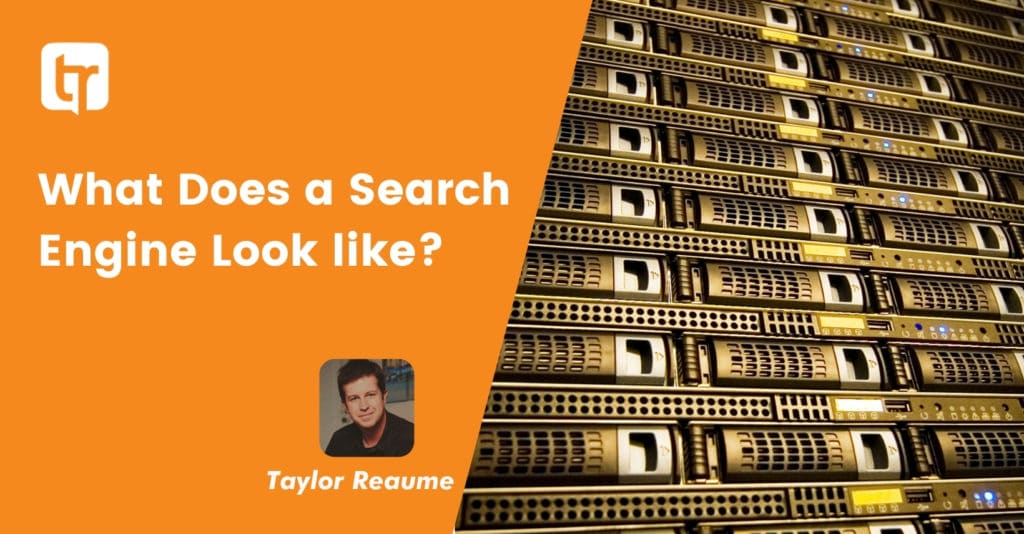
In the words of Swiss technophilosopher René Berger, “It’s becoming impossible not to visit with Google daily”. But when you do, what do you visit exactly? In other words: what does a search engine really look like? It actually looks like this:

This picture of Google’s new server farm in The Dalles, Oregon was published a couple weeks ago in the New York Times. The facility, which is under construction, is only one of several Google data centers, but John Markoff and Saul Hansell in their article speculate that it may “soon be one of the world’s most powerful supercomputers”. TED sponsor Google is known primarily as a search engine, they write, but it is actually “foremost an effort to build a network of supercomputers (…) that can process more data, faster and cheaper than its rivals”. The choice of The Dalles as the location of the data center has apparently to do with the availability of low-cost electricity (the grey structures protruding from the two football-field-sized buildings on the left are cooling towers) and easy access to data networks.

Markoff and Hansell have some interesting figures: In March 2001, when Google was serving about 70 million pages a day, its computing system had about 8’000 servers; by 2003 that number had grown to 100’000. Today “the best guess is that Google has more than 450’000 servers spread over at least 25 locations around the world”. For comparison, they write, Microsoft’s Internet activities currently use some 200’000 servers. In a recent Fortune article, TED regular David Kirkpatrick puts the number of Google servers around the world at one million and confirms that Microsoft is also investing billions in infrastructure. Kirkpatrick quotes Microsoft’s Ray Ozzie: “Just think about where there are windmills, dams, and other natural power sources around the world: that’s where you’re going to see server farms”. http://blog.ted.com/2006/07/05/what_does_a_sea/

SEO & The Battle Of Perceptions

SEO & The Battle Of Perceptions
final seopros header2

SEO is a form of marketing on the internet called Search Engine Optimization.  One reason why it’s smart to start off your web project with SEO as your chosen  marketing medium is because this form of marketing deals with polishing your reputation as the strategy is executed.

As the old saying goes: “It’s great if you get 1000’s of visitors to your web site, not so great if they don’t buy (convert).”

Marketing is the battle of perceptions.  Marketing is needed for all businesses to stay competitive.

In today’s talk, we’ll discuss the battle of perceptions as it related to SEO and the online marketing world.

Starting a web site business is not easy – it’s frought with challenges and often simply understanding what’s being recommended and the costs associated can be like a big algebra problem.

For most businesses the cost of doing nothing is far greater than the cost of the marketing plan.    Similar to diet and excersize, most business owners realize they need to focus on their web strategy to stay in business.

To be successful, one must reinforce perceptions. Having a better offering is a prerequisite.  Having a better story is the catalyst.  Find a way to add massive value efficiently, do something remarkable and get people to love you.

Looking forward to seeing everyone at the class today at 5:30pm -Taylor

When: Thursdays Nights 5:30pm-6:30pm ADD OUTLOOK REMINDER
Where: THE EAGLE INN (by Sambos) 232 Natoma Ave Santa Barbara, CA 93101

TO SEO? OR TO PPC?

TO SEO? OR TO PPC?

The internet is rapidly becoming the most important marketing venue for businesses today.  The world wide web simply cannot be ignored if you are in business to make a profit today.  There are thousands if not millions of consumers Googling and Facebooking their way to the better deals and faster service on the web.

Internet marketing trends like SEO (Search Engine Optimization) and PPC (Pay Per Click) are requiring business owners to increase their computer literacy skills and spend more time doing “listening” marketing.

Having a website is not enough to keep a business competitive today. You have to expose your website. Make it known. It has to be visible. It has to be frequently targeted by consumers and surfers.

Marketing an internet site is not an easy task –it’s fraught with challenges and seemingly easy tasks that  end up being huge time consuming projects that take the business owner away from core business activities.

When it comes to the world of internet marketing, two of the most popular options available are SEO and PPC.

The Internet has now become an important medium for product and service advertisements. Almost every company that can afford print, radio and TV advertisements has ventured into placing ads on the Internet and optimizing their web site for the search engines. In this week’s discussion, we’ll discuss which business models benefit most from SEO vs PPC, and when they might be appropriate for your business. 

The Thursday SEO workshop is a group of local business owners talking about how to generate more leads from their website via google site optimization and pay per click. Attendees come to learn SEO and search engine marketing from other like-minded business owners who have developed effective internet marketing strategies. The SEO class is located at 232 Natoma Ave Santa Barbara, CA 93101   Phone (805) 965-3586.  The class begins with 30 second introductions, followed by a short 15 minute speech by Search Engine Pros Founder Taylor Reaume on the weekly discussion topic. For the remainder of the hour, Taylor Reaume answers questions for those enrolled in the Mentorship Program.  Remember to bring your laptops and let’s get ready to Google! -Taylor

When: Thursdays Nights 5:30pm-6:30pm ADD OUTLOOK REMINDER
Where: THE EAGLE INN (by Sambos) 232 Natoma Ave Santa Barbara, CA 93101

Crossing The Chasm – Beautiful Web Design Without Sacrificing SEO Friendliness

Crossing The Chasm – Beautiful Web Design Without Sacrificing SEO Friendliness

A Professional SEO Web Design Conversion Expert Will Design Eye Catching Banners & Embed Powerful Calls To Action Which Lowers Bounce Rates, Boosts Conversions, Increases Time On Site (Which Increases Rankings)-And Doubles Your Sales

Did you know that the majority of web sites today are not using a “call to action” approach?  “Call to action” and “direct response” methodology is about making the user experience better at your web site. Most web sites expect visitors to “figure it out” by themselves.  Instead of making people wander about your web site in low impact areas, hunting for what they want, we fine tune the user experience by creating lots of call to action messages that capture attention.  People have very little patience on the internet.  Figure out what people are looking for, and stick it right up there in front of them in bright lights, with simple instructions on how to proceed.  It’s great if you drive 100,000 people to your web site, NOT SO GREAT if they don’t buy due to a complex maze at your site that ends at a dull off topic article. A smart Web Design & Conversion Pro helps you kick your design from 1999, and turn your site into a GOOD MAZE that will maximize your conversions and sales.

SEO is Promotion that Doesn’t Sleep. Imagine having your own marketing company working exclusively for you, 24 hours a day, 7 days a week, 365 days every year. That’s the benefit of SEO!

Optimized Web Sites Increase Brand Visibility: SEO gives your brand more exposure on the web. 

More exposure increases your brand visibility.  Increasing your brand visibility means more customers will know like and trust your product or service and will be more likely to buy from you.  Optimized web sites generate higher rankings in Google which leads to increased sales of your product or service.

SEO Managers are constantly trying to stay ahead of search engine updates and keep your web site compliant with the ever evolving search engine guidelines.

The goal of the SEO Manager is to consistently optimize the web site code for high search term key phrases.  The SEO Manager is also available to help you complex (and often critical) decisions regarding web design and impacts on search engine traffic.

The weekly rank report will show how the ranks are moving, either up or down. Ranks will rise or fall in relation to the SEO efforts of your competitors, and the amount of SEO you are doing on a monthly basis.

The Thursday SEO workshop is a group of local business owners talking about how to generate more leads from their website via google site optimization and pay per click. Attendees come to learn SEO and search engine marketing from other like-minded business owners who have developed effective internet marketing strategies.

2011 06 11 21350900016

When: Thursdays Nights 5:30pm-6:30pm ADD OUTLOOK REMINDER 
Where: THE EAGLE INN (by Sambos) 232 Natoma Ave Santa Barbara, CA 93101Agenda / Format for the group:

-15 minutes: 30 Second Introductions

-15 Minutes: Quick Speech By Taylor Reaume on the Topic Of The Week

-30 minutes: SEO Mentorship questions

-Taylor

Best Regards, : )