Bing Search: Microsoft’s entry into the burgeoning search engine market. Better late than never.
Yahoo! Search: The 2nd largest search engine on the web (as defined by a September 2007 Nielsen Netratings report.
AltaVista: Launched in 1995, built by researchers at Digital Equipment Corporation’s Western Research Laboratory. From 1996 powered Yahoo! Search, since 2003 – Yahoo technology powers AltaVista.
Cuil: Cuil was a search engine website (pronounced as Cool) developed by a team of ex-Googlers and others from Altavista and IBM. Cuil, termed as the ‘Google Killer’ was launched in July, 2008 and claimed to be world’s largest search engine, indexing three times as many pages as Google and ten times that of MS. Now defunct.
Excite: Now an Internet portal, was once one of the most recognized brands on the Internet. One of the famous 90’s dotcoms
This is a great article by Survey Monkey that discusses survey best practices, enjoy!
Survey Monkey is a great service and we highly recommend it to all our clients for market research.
-Taylor Reaume
If you’re getting ready to send an online survey, you probably already have some questions in mind for your audience. No doubt about it — the questions you ask your respondents are important and should be well thought out. Equally important (though less well known) are the questions you ask yourself before you send your survey. These 5 basic questions — how, why, who, when, & what — don’t get as much attention as the more popular questions you include in your survey. But they should. Take a few minutes to answer these 5 questions before you start writing your survey. Your results will thank you for it.
Questions To Ask Yourself Before You Send Your Survey
1. How: How do you want to ask?
Okay, this is the easy part. After all, you’re reading this blog because you already decided that you want to use an online survey to do the asking for you. So really, the place to start is our second question…
2. Why: Why do you want to ask?
The most important step in a survey is figuring out what you actually want to know. It’s important to make your objectives really clear up front or the next steps of survey formation won’t go so well. For example, stay away from vague goals like measuring “satisfaction.” What do you mean by satisfaction? Do you want to know if your public awareness campaign was engaging and fun? Or if it was informational? Or persuasive? Not only will a clear sense of the feedback you want up front help you to analyze your data when you get it back; it will also make your actual survey questions clearer and simpler—something that the people answering your survey will definitely appreciate. Which brings us to our next question…
3. Who: Who do you want to ask?
This may seem like a silly question, but it really is very important. Survey respondents should be a “sample” of a “population.” A population is the entire set of people who you want to ask. For example, American citizens, or non-profit workers in Texas, or teenage internet users in New York City. Yoursample is the portion of that bigger population that actually ends up taking your survey. You can think of a population as all the fish swimming around in the Pacific Ocean and a sample as all the fish you caught on Tuesday afternoon. Figuring out which fish you want to catch (so to speak) is directly related to why you’re fishing in the first place. That is, figuring out who you want to answer your questions is directly related to why you’re asking in the first place.
Let’s say you’re a non-profit looking to make sure you get lots of donations for your next year. Do you want to make sure your current donors are happy with the way you are spending their contributions? Or are you trying to figure out how to attract new donors? If it’s about your current donors, then your population would be all of your current donors and to access that population, just send your survey out to your mailing list of donors. Your sample will be the people who actually respond and fill out the survey. If you’re trying to get new donors, however, it gets a little trickier. First you have to spend a little more time defining who your population is exactly. That is, who could potentially donate to your organization? Adults probably. Maybe only English-speaking adults. Maybe if you’re a local, grassroots organization, maybe only American adults who live in San Francisco. It’s really up to you! Now that we’ve tackled the question of who to ask, let’s move on to our next question…
(*Survey Tip* Need help accessing a sample of your target population? We have an Audience available to take your surveys.)
4. When: When do you want to ask?
So, to understand the “when,” let me bring us back to the fishing metaphor. When you go out fishing, how many fish you catch can depend on what time you go out to fish and how long you stay out there. Some kinds of fish tend to be easier to catch in the morning, others at night. Fishing for 2 hours will yield a different catch than fishing for 2 days. In surveys, depending on who you want to “catch,” you’re going to want to send out invitations at different points of the week, and leave surveys open for different amounts of time—especially if you want to get more responses. Closing a survey too quickly can frustrate people who tried to respond, and exclude people who are just a little slower at getting around to things. This could potentially bias the conclusions you draw in an unhelpful way. For example, if you’re trying to recruit new donors, you might be interested in what would motivate people who don’t tend to be quick responders. When you ask also depends on the actual substance of what you’re asking, which brings us to our next question…
5. What: What do you want to ask?
Finally. The question you’ve all probably been waiting for. You’ve got your objectives and your sample population nailed down. You’ve figured out when to ask them. But your survey is still blank. What do you ask?! Well, that’s a complicated problem, and there’s not just one right answer. If you have clear answers to the last four questions, it should make the “what” part a lot easier. There are so many different kinds of question designs and factors to consider, but here are some general guidelines to get you started:
First of all, keep your questions simple, straightforward, and concise. This will make it easy for your survey-takers to understand what you’re asking, and will make it easy for you to analyze your data. If you’re not sure if your questions are easy enough to understand, test them out on a friend or someone who’s not familiar with your particular industry to make sure the questions are comprehensive. Next, if you’re going to give your survey-takers answer choices, try not to use more than 7 answer choices for any given question—people get overwhelmed. Also, make sure to label the answer choices. So that means don’t ask your survey-takers to rate how happy they are on a scale of 1 to 5. Ask them if they’re extremely happy, very happy, moderately happy, slightly happy, or not at all happy. Words are easier for people to think about than numbers.
There you have it. Stick with those 5 questions, and your survey will be off to a good start before you’ve even started writing it! What do you think? Have other survey methodology questions? Share your thoughts and comments with us in the comment section below. Thanks
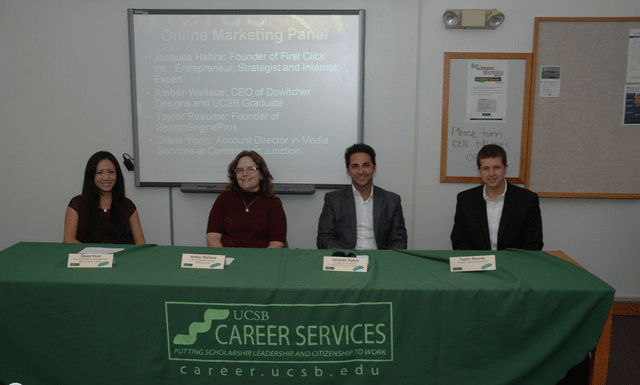
Taylor Reaume, founder of Santa Barbara marketing company Search Engine Pros will be a panelist at UCSB’s “Careers In Online Marketing and Social Media” presentation. The event is expected to be a highly valuable and rewarding experience for UCSB students. The panel will be held on Tuesday, May 15th from, 4:00-5:30pm @ Career Services, Building 599, Room 1109.
Each panelist will have 10-15 minutes to cover the following:
How did you get to where you are? What does your career path look like? What/who influenced you to choose this type of work? Are you still in this field? What barriers might students face wishing to enter this field? How did you overcome any of these barriers? What tips would you give to students wishing to enter this field? Do they need special training or expertise in a certain area?
**There will be Q&A from the students immediately following the panel discussion**
Taylor will speak to the importance of internships and explain how they provide essential “transferrable skills” and clarity with your career path.
For more information contact The Search Engine Pros at 800-605-4988 or Emily White Career Counselor, Career Services, University of California, Santa Barbara (805)-893-4412 http://career.ucsb.edu
Online Africa is developing even faster than the new highways of offline Africa. Undersea cables reaching Africa on the Atlantic and Indian Ocean coasts, plus innovative mobile-phone providers, have raised internet speeds and slashed prices. In some African markets, you can buy a daily dose of internet on a mobile phone for about the cost of a banana (ie, less than ten American cents). This burgeoning connectivity is making Africa faster, cleverer, and more transparent in almost everything that it does.
Google can take a lot of the credit. The American search-and-advertising colossus may even be the single biggest private-sector influence on Africa. It is not just that its internet-search and e-mail are transforming Africa. Take maps. Before Google, ordinary Africans struggled to find maps. Military and civilian mapping offices hoarded rolls of colonial-era relics and sold them at inflated prices. By contrast, Google encourages African developers to layer maps with ever more data. In Kenya 31,000 primary schools and 6,900 secondary schools are marked on Google maps. Satellite views even let users see if the schools have built promised new classrooms or water points. Similar initiatives let voters verify local voting figures at election time. Satellite views of traffic jams have also shamed some African cabinets into spending more on city infrastructure.
Google has also pepped up Africa’s media, enabling Africans to read each other’s newspapers. Google is improving translation software to bring more Africans who speak only local languages online. As well as English, French, Portuguese and Arabic, it offers Zulu, Afrikaans, Amharic and Swahili. Languages like Wolof, Hausa, Tswana and Somali are set to follow.
Let critics complain that Google is buying up enormous amounts of virgin digital land in Africa at virtually no cost. Within a couple of decades, without the regulatory oversight of the African Union or African governments, they say, Africa’s internet life will be almost entirely in hock to the Google giant. Even the company’s decision to go slow on seeking profits from Africa by offering cheap deals has been attacked by African would-be rivals, which say that such tactics are only extending Google’s unfair advantage.
Faster downloading speeds have helped make Google’s YouTube video-viewing more popular. Young urban Africans organise YouTube parties. The company is also trying to help African governments digitise information and make it freely available to their citizens. Many rulings in the higher courts of Ghana, for instance, are going online.
Google says its recent effort to best a rival South African firm, Mocality, was an embarrassing aberration. Google’s top man in Africa, Joe Mucheru, brushes aside fears of a monopoly. The company’s advertising model, he says, helps African business. “The more Google grows, the more the entire ecosystem grows.” He is especially keen on Google+, a service that seeks to provide an even more useful online community than Facebook.
Businesses with multiple locations have a big task in front of them when trying to manage their online presence. How can they connect their customers with the locations closest to them? How can they make data changes to a group of their locations all at once? The challenges of managing multiple businesses in the real world can sometimes carry over online.
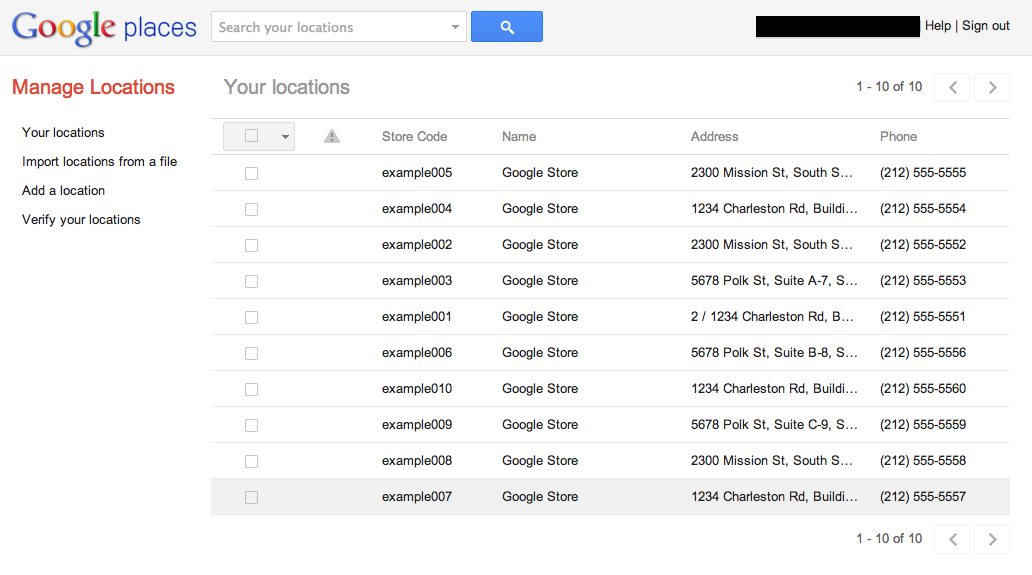
We’ve heard plenty of feedback about how you want to manage your listings on Google, which is why we’re excited today to announce an upgraded bulk listing management tool for Google Places for business.
We’ve made many improvements and now enable the following actions:
Edit one or more of your listings’ data at once
Search through your listings, filtering by specific information or for listings with errors
Upload new listings using a data file or by adding them individually within the interface
Tell us how we can improve this new interface by clicking the “Give Feedback” link
Before you get started with the new bulk management tool, watch the video tutorial that’s relevant to you or visit our Help Center for more information:
New user? Learn how to manage multiple locations. Already managing verified listings? Here’s what’s new.
Starting today, you’ll be routed to the new interface whenever you click to upload or edit a data file via the Places dashboard, or by visiting https://places.google.com/manage directly. You’ll still use the Places dashboard to see your listing analytics and to perform PIN verification on single locations. Remember that your updates will still take a few days to appear on Google Maps.
We hope the new tool makes managing your business on Google Places much easier. We look forward to hearing your feedback and seeing your listings up on Google Maps!
SUMMARY: Search Engine Pros will have a booth at the “Brand Yourself for Success” event tonight out at the University of California, Santa Barbara from 5pm-7pm Come learn about internship opportunities and why so many students are turning to the field of internet marketing as a career path.
FOR IMMEDIATE RELEASE, SANTA BARBARA, CA – What is your personal brand? Do you know how to sell yourself to employers? This special event will feature guest speaker Arlene Stepputat who will teach you how to authentically define who you are and utilize your listening skills to better position yourself when networking with others. Learn how to make a lasting first impression!
Location: Mosher Alumni House Time: 5:00 PM – 7:00 PM4/26/12
Following the lecture, you will have the opportunity to mingle with professionals from different industries (ex: business, accounting, engineering, government/law, education/nonprofit, art/fashion and more) in order to practice your networking skills. So dress professionally and start building your network. Hors d’oeuvres and refreshments will be served. RSVP through GauchoLink (http://career.?sa.ucsb.edu/stu?dents/gaucholin?k.html) by Thu, Apr 19 to reserve your spot. Follow RSVP instructions located under “Announcements” on GauchoLink’s homepage. Space is limited to 90 students. If you have any questions, see a peer advisor in the Career Resource Room or call 893-4414.
Take advantage of this amazing opportunity to learn how to effectively market and prepare yourself for today’s job market!
Google managers are pushing the Google Glass team to get an early version of the computerized glasses out as soon as they can, and it’s causing tensions in the group.
The report says that members of the product team behind Google Glass — which was called Wingfront until a couple months ago, when Google decided it needed a more release-ready name — are complaining that they need more time to perfect the product, but management is pushing to get the glasses out to developers as soon as possible. More people have recently been added to the team, increasing the strife.
Reportedly, the glasses spotted on Sergey Brin last night are only one of a bunch of prototypes. Google is also testing models that clip-on to regular glasses, and models that are built into sunglasses.
The company already has a small run available internally, says the report, and may try to get a prototype into developers’ hands at Google I/O in June.
on Quora from somebody claiming to be on the Google, Glass team said that the product is “quite far from” what’s being shown in the video. When The Verge asked Sergey Brin when the glasses would be available, he said “give us time.”
Below are 100 quotes from “The Secret” Movie that may help bring clarity to your thinking, and ignite your passions.
Passion First, money second.
-Taylor Reaume
We all work with one infinite power.
The Secret is the Law of Attraction (LOA).
Whatever is going on in your mind is what you are attracting.
We are like magnets – like attract like. You become AND attract what you think.
Every thought has a frequency. Thoughts send out a magnetic energy.
People think about what they don’t want and attract more of the same.
Thought = creation. If these thoughts are attached to powerful emotions (good or bad) that speed the creation.
You attract your dominant thoughts.
Those who speak most of illness have an illness, those who speak most of prosperity have it..etc.
It’s not “wishful” thinking.
You can’t have a universe without the mind entering into it.
Choose your thoughts carefully .. you are a masterpiece of your life.
It’s OK that thoughts don’t manifest into reality immediately (if we saw a picture of an elephant and it instantly appeared, that would be too soon).
EVERYTHING in your life you have attracted .. accept that fact. it’s true.
Your thoughts cause your feelings.
We don’t need to complicate all the “reasons” behind our emotions. It’s much simpler than that. Two categories .. good feelings, bad feelings.
Thoughts that bring about good feelings mean you are on the right track. Thoughts that bring about bad feelings mean you are not on the right track.
Whatever it is you are feeling is a perfect reflection of what is in the process of becoming.
You get exactly what you are FEELING.
Happy feelings will attract more happy circumstances.
You can begin feeling whatever you want (even if it’s not there).. the universe will correspond to the nature of your song.
What you focus on with your thought and feeling is what you attract into your experience.
What you think and what you feel and what actually manifests is ALWAYS a match – no exception.
Shift your awareness.
“You create your own universe as you go along” Winston Churchill
It’s important to feel good ( ( ( (((good))) ) ) )
You can change your emotion immediately .. by thinking of something joyful, or singing a song, or remembering a happy experience.
When you get the hang of this, before you know it you will KNOW you are the creator.
Life can and should be phenomenal .. and it will be when you consciously apply the Law of Attraction.
Universe will re-arrange itself accordingly.
Start by using this sentence for all of your wants: “I’m so happy and grateful now that…. ”
You don’t need to know HOW the universe is going to rearrange itself.
LOA is simply figuring out for yourself what will generate the positive feelings of having it NOW.
You might get an inspired thought or idea to help you move towards what you want faster.
The universe likes SPEED. Don’t delay, don’t second-guess, don’t doubt..
When the opportunity or impulse is there .. ACT
You will attract everything you require – money, people, connections.. PAY ATTENTION to what’s being set in front of you.
You can start with nothing .. and out of nothing or no way – a WAY will be provided.
HOW LONG??? No rules on time .. the more aligned you are with positive feelings the quicker things happen.
Size is nothing to the universe (unlimited abundance if that’s what you wish) We make the rules on size and time.
No rules according to the universe .. you provide the feelings of having it now and the universe will respond.
Most people offer the majority of their thought in response to what they are observing (bills in the mail, being late, having bad luck…etc..)
You have to find a different approach to what is through a different vantage point.
“All that we are is a result of what we have thought” – Buddha
What can you do right now to turn your life around?? Gratitude.
Gratitude will bring more into our lives immediately.
What we think about and THANK about is what we bring about.
What are the things you are grateful for?? Feel the gratitude.. focus on what you have right now that you are grateful for.
Play the picture in your mind – focus on the end result.
VISUALIZE!!! Rehearse your future.
VISUALIZE!!! See it, feel it! This is where action begins.
Feel the joy .. feel the happiness :o)
An affirmative thought is 100 times more powerful than a negative one.
“What this power is, I cannot say. All I know is that it exists.” Alexander Graham Bell.
Our job is not to worry about the “How”. The “How” will show up out of the commitment and belief in the “what.”
The Hows are the domain of the universe. It always knows the quickest, fastest, most harmonious way between you and your dream.
If you turn it over to the universe, you will be surprised and dazzled by what is delivered .. this is where magic and miracles happen.
Turn it over to the universe daily.. but it should never be a chore.
Feel exhilarated by the whole process .. high, happy, in tune.
The only difference between people who are really living this way is they have habituated ways of being.
They remember to do it all the time.
Create a Vision Board .. pictures of what you want to attract .. every day look at it and get into the feeling state of already having acquired these wants.
“Imagination is everything. It is the preview of life’s coming attractions.” Albert Einstein.
Decide what you want .. believe you can have it, believe you deserve it, believe it’s possible for you.
Close your eyes and visualize having what you already want – and the feeling of having it already.
Focus on being grateful for what you have already .. enjoy it!! Then release into the universe. The universe will manifest it.
“Whatever the mind of man can conceive, it can achieve.” W. Clement Stone
Set a goal so big that if you achieved it, it would blow your mind.
When you have an inspired thought, you must trust it and act on it.
How can you become more prosperous?? INTEND IT!!
“Checks are coming in the mail regularly”… or change your bank statement to whatever balance you want in there… and get behind the feeling of having it.
Life is meant to be abundant in ALL areas.
Go for the sense of inner joy and peace then all outside things appear.
We are the creators of our universe.
Relationships: Treat yourself the way you want to be treated by others .. love yourself and you will be loved.
Healthy respect for yourself……
For those you work with or interact with regularly .. get a notebook and write down positive aspects of each of those people.
Write down the things you like most about them (don’t expect change from them). Law of attraction will not put you in the same space together if your frequencies don’t match.
When you realize your potential to feel good, you will ask no one to be different in order for you to feel good.
You will free yourself from the cumbersome impossibilities of needing to control the world, your friends, your mate, your children….
You are the only one that creates your reality.
No one else can think or feel for you .. its YOU .. ONLY YOU.
Health: thank the universe for your own healing. Laugh, stress free happiness will keep you healthy.
Immune system will heal itself.
Parts of our bodies are replace every day, every week..etc… Within a few years we have a brand new body.
See yourself living in a new body. Hopeful = recovery. Happy = happier biochemistry. Stress degrades the body.
Remove stress from the body and the body regenerates itself. You can heal yourself.
Learn to become still .. and take your attention away from what you don’t want, and place your attention on what you wish to experience.
When the voice and vision on the inside become more profound and clear than the opinions on the outside, then you have mastered your life.
You are not here to try to get the world to be just as you want it. You are here to create the world around you that you choose.
And allow the world as others choose to see it, to exist as well.
People think that if everyone knows the power of the LOA there won’t be enough to go around. This is a lie that’s been ingrained in us and makes so many greedy.
The truth is there is more than enough love, creative ideas, power, joy, happiness to go around.
All of this abundance begins to shine through a mind that is aware of it’s own infinite nature. There’s enough for everyone. See it. Believe it. It will show up for you.
So let the variety of your reality thrill you as you choose all the things you want and get behind the good feelings of all your wants.
Write your script. When you see things you don’t want, don’t think about them, write about them, talk about them, push against them, or join groups that focus on them… remove your attention from don’t wants.. and instead place them on DO wants.
We are mass energy. Everything is energy. EVERYTHING.
Don’t define yourself by your body .. it’s the infinite being that’s connected to everything in the universe.
One energy field. Our bodies have distracted us from our energy. We are the infinite field of unfolding possibilities. The creative force.
Are your thoughts worthy of you? If not – NOW is the time to change them. You can begin right where you are right now. Nothing matters but this moment and what you are focusing your attention on.
Search Engine Marketing has become the talk of the day for online businesses. Many websites hire the services of search engine marketing consultantsto facilitate traffic generation at their web site. But search engine marketing doesn’t need to be prohibitively expensive; budget SEO can be acquired that will still increase market share, enhance brand recognition, and increase web site traffic without imposing unnecessarily high costs.
Top three reasons why the services of search engine marketing consultants should be hired are:-
Search engine marketing consultants provide various services and internet marketingsolutions crucial for achieving positive results from the SE marketing efforts.
Search engine marketing consultants are professional internet marketing experts who have gained expertise in the art and science of search engine marketing. These professionals are multi-faceted with talent in copywriting, web designing, effective code programming, link development, and expert analysis skills. Their target is to design a site that is user friendly and also easy to navigate.
Search engine marketing consultants also produce search engine optimization reports objectively, determining the effectiveness of search engine marketing strategies, and give advice to the clients on enhancing their website rankings in search engine listings. Budget SEO can easily be achieved through this; search engine optimization isn’t necessarily expensive.
To yield optimum results from search engine marketing, paid search engine marketing methods are applied for maximum ROI.
Budget SEO is not an oxymoron. Many search engine marketing consultants are willing to work with their clients to achieve their internet marketing goals within the confines of their budgets. Budget SEO can come in many forms, but the worst way to go about it is to ignore the power of natural search because it is deemed out of reach. The majority of product and service searches now take place at the largest search engines; without tapping into the traffic and revenue potential of natural search, a company is easy forgoing what might be the majority of their traffic.
“SEO articles are extremely effective at generating more awareness for your business on the internet andcommonly used by search engine optimization specialists to generate top ranks on search engines.”
SEO writing is one of the fastest growing marketing mediums for small businesses today. SEO article writing is a strategic business writing style where the objective is to rank high in the search engines for a particular keyword or key phrase. Ideally, you will have several different keywords to use, and each keyword should normally be used at least once per paragraph – though the exact guidelines for SEO article writing vary from one company to the next depending on comfort levels with writing styles.
In the past 10 years I have written and published over 10,000 pages of SEO articles on the web for my clients, and my own web sites. I was fortunate to have the opportunity to work under some very bright SEO writers, and I picked up some gems of web publishing wisdom from them. Below are a few quick tips that might help you write your SEO articles in a way that will increase your ranks on Google and other major search engines. Enjoy.
1. SEO articles are “strategic content’.
Search engine optimized articles are considered to be “strategic content” for your web site (relevant + keyword rich). Strategic content is essentially a block of informational (typically non-self promotional) text that contains the keywords that are important to your business. Google loves web sites that contain helpful, objective keyword rich articles.
2. SEO articles strike a balance between Ernest Hemingway and Google.
Always err on the side of readership and style, when it comes to stuffing keywords inside. The goal of the SEO Article is to drive people to your web site from the search engines, and do so in a way that is graceful, not spammy. In most cases readers will spend less than a minute glossing the SEO article, and then click to the homepage (internet surfers are usually in a hurry). SEO articles are generally 500-1000 word blocks of factual, helpful ‘informational’ text (writer is confined to a set of keywords). The title of your web page, blog post, blog article, etc, is one of the most important areas to consider. Consider adding your target keyword first like this: Keyword – 7 Big Mistakes To Avoid. The reasoning behind this is because Google considers the keywords in the beginning of your title more important than those at the end of your title. Also consider using this little tool for keeping your titles and descriptions within an acceptable character range.
3. SEO articles are ‘educational marketing’ (pull marketing).
SEO articles educate and inform customers in a non self promotional way (informational). Part of the success of a business today depends on the business owners ability to add value to the customer base through their web site. Adding SEO articles is one of the best ways to do this because they increase credibility levels at your site, and generate top ranks in Google search results.
4. SEO articles are typically written specifically for the search engines.
SEO articles help search engines find your product or service. It seems that the majority of writers today, including press release writers, are including SEO keywords in their articles to increase visibility in the search engines. SEO articles are specifically written for search engines. The reason companies today are writing SEO articles is primarily because they make the phone ring with new prospects. SEO articles generate awareness of a product or service online and help prospects easily discover your product or service. New visitors at your web site results in more sales and more success. Google loves to rank web sites highly that have helpful directories of how-to articles.
5. SEO articles are a different animal than Magazine articles.
This is often times a point of confusion for business owners, poets and journalists. SEO articles tend to be more factual in nature, not taking serious points of view on the industry, but rather, just finding creatives ways to connect the target audience with the search engine audience by using embedded keywords that customers use when searching for your product or service. In contrast, with magazine articles, the writer has full freedom of expression, and generally has a goal of getting the reader excited. The type of writing that you see in magazines is more motivational and compelling. With most SEO articles, this will not be the case and shouldn’t be the case. SEO articles aim to be short, factual, helpful and keyword rich. A greater degree of flexibility is typically afforded for the literary aspects of SEO articles for this reason. SEO articles are not written for a magazine or for your homepage. They are written primarily for the search engines and to build in-roads to your web site (links), and ultimately to generate more traffic for your web site. That said, they are still helpful and informative for the reader.
6. SEO articles have Twitter streams or RSS streams.
Google loves to rank fresh content. Hence, it would make sense to keep your pages (blog posts) fresh. You might consider adding a Twitter Stream (such as the one you see at the bottom of this SEO article) to keep the page fresh. *Adding video/audio helps as well in terms of keeping the visitor on your website for a longer period of time (time on page is measured as well when ranking websites).
7. SEO articles using a list based writing format.
This is because most people on the web are scanning, not reading. Most people prefer to read list based content. Just take yourself as an example, do you prefer reading big blocks of text on the web? Probably not. List based writing is a way to get your message across on the web. SEO articles utilize proper keyword density. Do not overuse the keywords. If you saturate the article with too many SEO keywords, it is difficult to maintain the flow and a style of the article. Always opt for readership over stuffing a bunch of keywords in the article. Google may even penalize you for “keyword stuffing” if your keyword density is too high.
8. SEO articles bold and italicize the SEO Keywords.
Bolding and italicization on certain text inside your SEO articles might score additional points in the search engines for certain keywords. Scoring systems consider bolded and italicized keywords to be more important (more emphasis) on the page. The same holds true for heading tags, such as h1, h2, h3, etc.
9. SEO articles use ‘anchor text’.
Anchor text is king, and the king rarely shows up these days. This is one of the most overlooked areas of SEO article writing, and it’s simply a matter of internally linking 5-10 key phrases to relevant pages inside your site. Do not hyperlink the same target keyword back to itself. When linking keywords and keyphrases, try to make sure they have a handshake with the h1 tag and the title of the page you are linkingto. Also, double check that all links are using target=”blank” so they will open in a new window, which of course increases the numbers of instances of your brand in front of your customer. One of the best places to add anchor text is inside your “About The Author” box at the end of your article. Here’s a handy author box tool that might help you with formatting.
10. SEO articles use proper alt text on images.
Search engines cannot read images. They rely on ‘alt text’ (an html code tag, i.e. an alt tag), to help identify the image. Hence, it makes sense to use those SEO keywords inside the alt tags. Images really help spruce up your SEO article, and I always use an image in the very last line of the SEO article, embedded with the target keyword for that keyword.
These are just a few points to consider when writing SEO articles. I hope you enjoyed these tips on SEO article writing. I love to use a military analogy in the workshops I teach here in Santa Barbara: “Every page / post of your web site is like a ‘special operations’ agent. Their mission (should they accept it) is to rank for a particular keyword. Marketing is a battlefield. Are you winning in the search engine wars?
The search engines are constantly evolving and keeping writers guessing on the best practices. Remember, practice makes perfect and the best way to approach SEO article writing is to focus on the user first, and robots second. Consider following the About.com & Wikipedia writers and study their writing styles as they post new